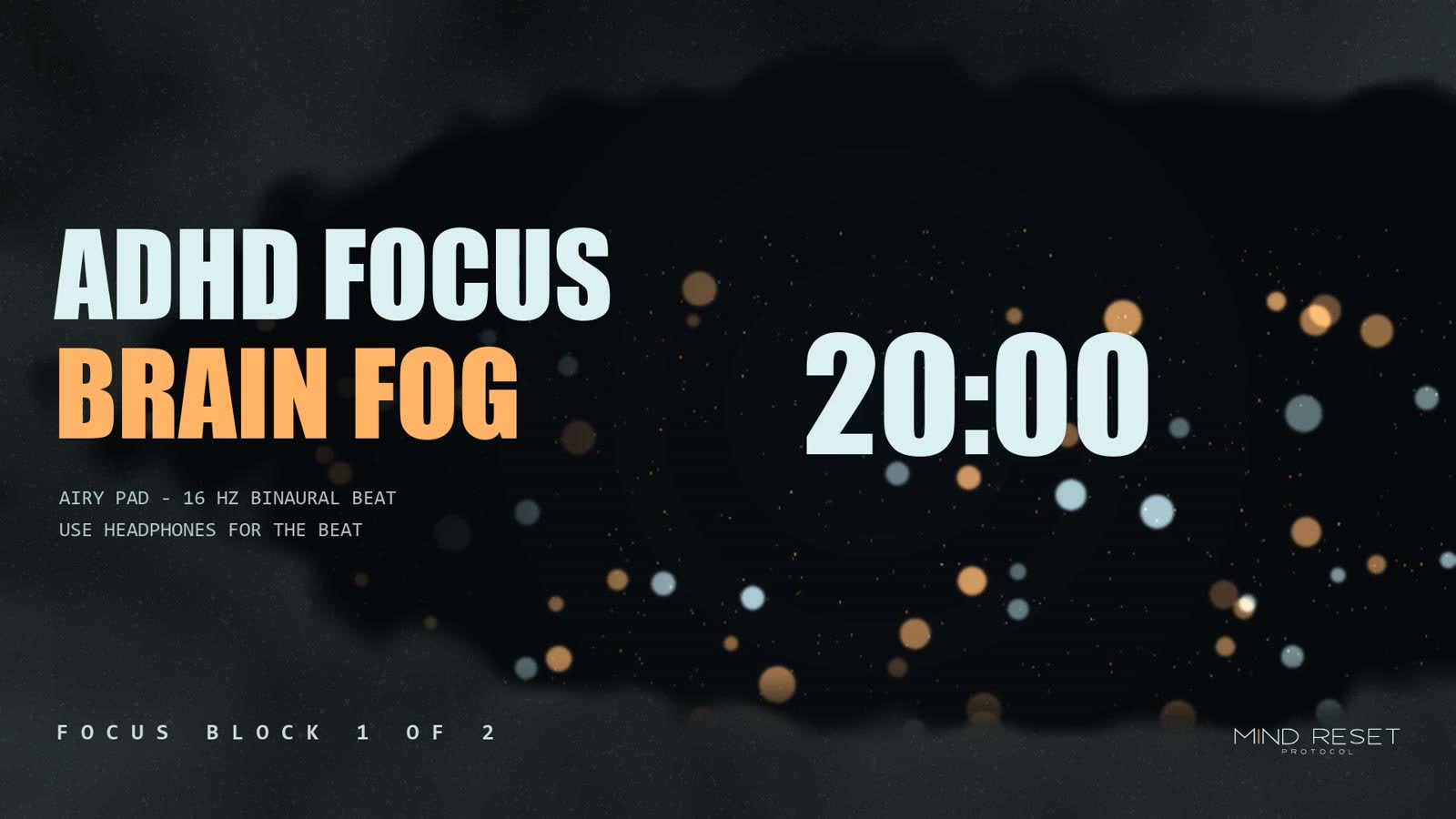
Too much going on. Every small sound around you pulls at your attention, and your own head won’t go quiet. You still have work to do, and everything feels loud. This session is built for that moment.
I’m not diagnosed with anything. I’m just very easy to distract, and on loud days every little noise gets in. What helps me then is a very simple setup: one deep, steady sound that covers the small noises, and long stretches where nothing changes. So I read the research to find out which sounds actually have evidence behind them, and I build every session from that. This page shows you what’s in this one and how strong the evidence is for each part, including the part with no research at all.
How to use it
- Before you press play, write down the one thing taking up the most room in your head. You can park it in the YouTube comments. It will still be there at the break.
- Pick one task for the first 50 minutes. Only one.
- Put your headphones on if you have them. Putting them on tells you it’s time to work. Speakers are fine too.
- When the chime goes, take the full 10 minutes. Stand up, drink some water, look away from the screen. The next chime brings you back.
The full session is 2 hours: a short voice intro, then two rounds of 50 minutes of focus and 10 minutes of rest. That’s only four changes in two hours. The chapters in the video description let you jump to either round.
What’s in the sound, and why
Deep brown noise
The main sound is brown noise, a deep, steady rumble a bit like strong wind far away or the inside of a plane. It stays even the whole way through, so it covers the small sounds around you, like voices in the next room or a door closing.
No study has tested brown noise for focus. I use it because many people like it, me included, and because a deep, even sound is easy to stop noticing after a few minutes. If it works for you, that’s a good enough reason to keep using it.
Evidence: none. There is no research on brown noise and focus yet, in either direction.
A little pink noise
Mixed into the brown noise is a small amount of pink noise, a lighter, even hiss like steady rain.
A 2024 review that pooled the lab studies found that white or pink noise gave a small boost to attention for people with ADHD or high ADHD traits, and slightly hurt focus for people without them (Nigg et al., 2024). That’s why there’s only a little of it here. If noise usually bothers you, this may not be the session for you, and that’s fine.
During the breaks the noise drops a little, so the rest sounds different from the work.
Evidence: moderate, with a small effect, and it can go the other way for some people.
No melody, lyrics or speech
Apart from the short spoken intro at the very start, there are no words in this session and no tune to follow.
A large review of the research found that music with lyrics hurts reading, while instrumental music makes little difference either way (Vasilev et al., 2018). That covers the words. Leaving out melody as well is my own choice for this session. On a day when everything already feels loud, I wanted nothing in the sound that asks for your attention.
Evidence: strong (for “no lyrics or speech”, not for leaving out melody).
Long fixed breaks and a clear chime
The breaks come at set times, and a clear two-note chime marks every change, so you can stop watching the screen. In one study with students, fixed breaks were linked to less tiredness than breaks people chose for themselves, with the same amount of work done (Biwer et al., 2023). The study compared fixed and self-chosen breaks. It didn’t test 50 and 10 minute blocks, so the block length is my choice, made so you have fewer interruptions.
Evidence: weak to moderate, one study.
A dial timer with a soft tick
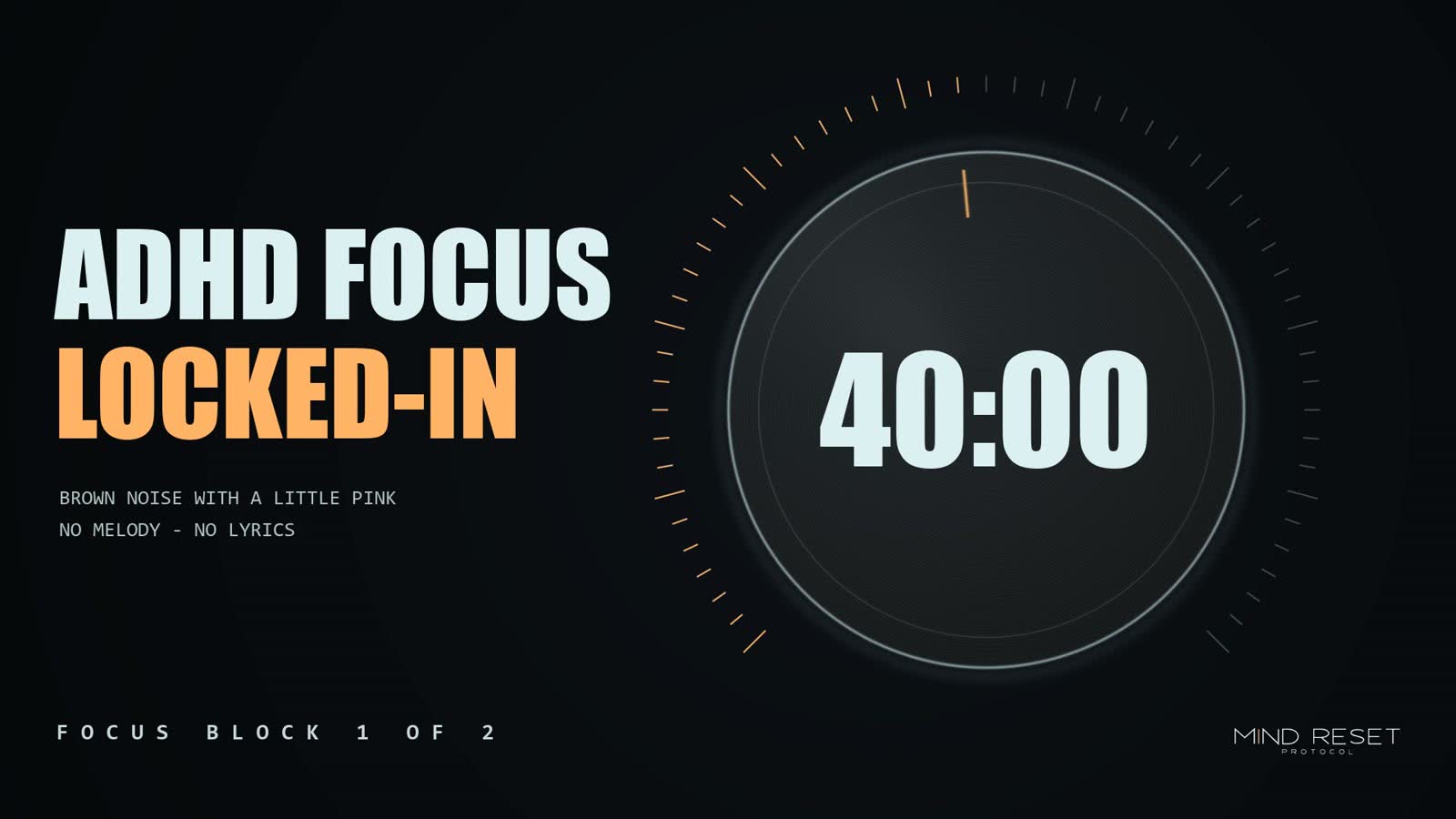
On screen, a big timer sits inside a dial that turns down as each block runs, and a soft tick plays once a second. Time can be hard to feel when everything is loud. Differences in how people with ADHD perceive time are well documented in research (Zheng et al., 2022). A visible timer is a simple, low-risk way to make the time in front of you feel finite. There’s no trial showing timers or ticks fix anything, so I offer them as a sensible aid, nothing more.
What this session doesn’t do
This is a focus tool, not a treatment. It doesn’t treat ADHD, it doesn’t replace medication or therapy, and it doesn’t change your brain. If you’re looking into ADHD care, please talk to your clinician.
Sources
- Nigg et al. (2024), Journal of the American Academy of Child and Adolescent Psychiatry 63(8): review and meta-analysis of white and pink noise for attention. https://ohsu.elsevierpure.com/en/publications/systematic-review-and-meta-analysis-do-white-noise-or-pink-noise-
- Vasilev et al. (2018), Perspectives on Psychological Science: review of studies on music, lyrics and reading. https://eprints.bournemouth.ac.uk/29995/
- Biwer et al. (2023), British Journal of Educational Psychology: fixed versus self-chosen study breaks. https://pubmed.ncbi.nlm.nih.gov/36859717/
- Zheng et al. (2022): meta-analysis of time perception differences in ADHD. https://www.caddra.ca/time-perception-deficits-in-children-and-adolescents-with-adhd-a-meta-analysis/
Every sound we use has its own page with the full research: the evidence hub.